
Kentucky Wine — Bourbon Country's Best-Kept Secret
Everyone knows Kentucky for bourbon. Far fewer know it for wine. That is a mistake worth correcting. The Bluegrass State has a wine history stretching back nearly two centuries, a growing roster of serious producers, and a terroir that rewards the grapes willing to work for it.
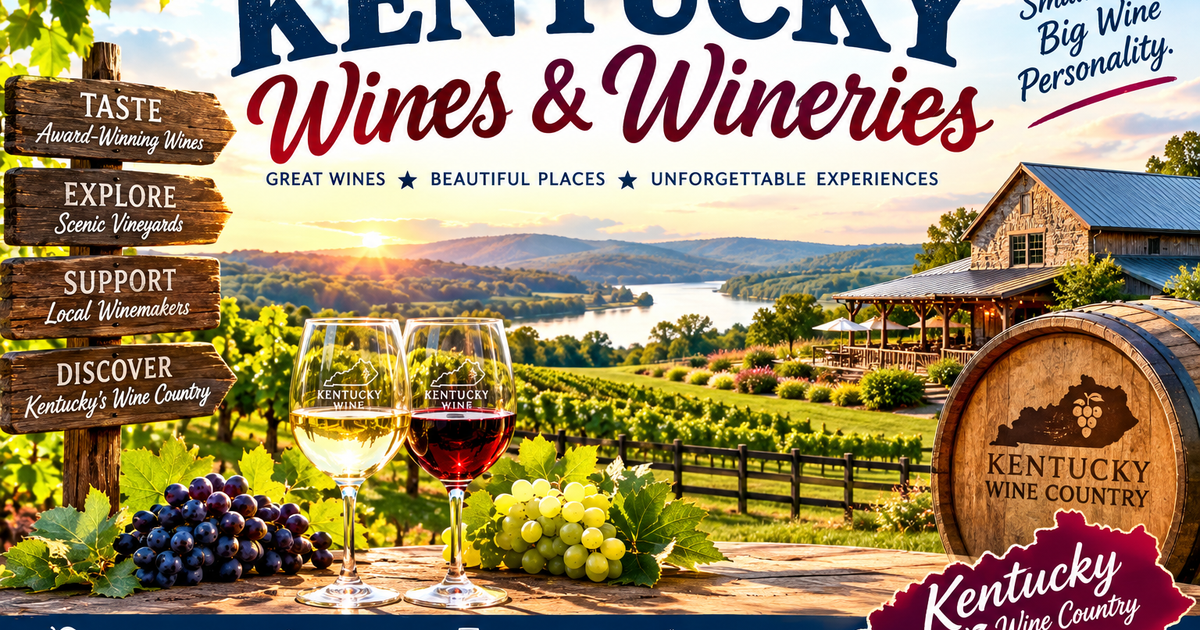
Kentucky Wine — Bourbon Country's Best-Kept Secret
Everyone knows Kentucky for bourbon. The white oak barrels, the limestone-filtered water, the rolling hills of the Bluegrass region — it is one of the most recognizable agricultural identities in America. What far fewer people know is that Kentucky has been making wine for nearly as long as it has been making whiskey, and that the state's wine industry is in the middle of a genuine renaissance.
Kentucky is not Napa Valley. It is not the Willamette Valley. It is something more interesting than either of those things: a wine region still in the process of discovering itself, where dedicated growers are figuring out which grapes belong here, which soils reward patience, and which traditions are worth building on. If you have been sleeping on Kentucky wine, this is the guide that will wake you up.
A History Older Than You Think
Kentucky's wine history begins in the early nineteenth century. The state's first commercial winery, the Kentucky Vineyard Society, was established in 1799 — just sixteen years after the end of the Revolutionary War. By the 1850s, Kentucky was one of the leading wine-producing states in the country, trailing only Ohio and California in total output.
The engine of that early industry was a grape called Catawba, a native American variety that thrived in the Ohio River Valley and produced wines that were genuinely celebrated in their time. Nicholas Longworth, a Cincinnati entrepreneur who planted extensively on both sides of the Ohio River, made a sparkling Catawba that was praised by Henry Wadsworth Longfellow in verse. Kentucky growers supplied much of the fruit that fed that early industry.
Then came Prohibition.
The Volstead Act of 1919 did not merely pause Kentucky's wine industry — it effectively erased it. Unlike California, which maintained a limited wine culture through sacramental and home-use exemptions, Kentucky's wine tradition was largely abandoned. When Prohibition ended in 1933, the state's bourbon industry recovered quickly. Its wine industry did not.
For most of the twentieth century, Kentucky wine was an afterthought. A handful of farm wineries operated quietly, but there was no organized industry, no state support, and no cultural identity around wine the way there was around spirits.
That began to change in 1976, when Kentucky passed the Farm Winery Act, allowing small producers to sell wine directly to consumers. It was a modest piece of legislation, but it planted a seed. By the 1990s, a small but growing number of producers were experimenting with hybrid and native varieties, learning what the Kentucky climate could and could not support. By the 2010s, the industry had grown enough to support a Kentucky Wine and Vine Festival, a Kentucky Proud marketing program, and a network of wine trails that drew visitors from across the region.
Today, Kentucky has more than 70 licensed wineries. That number is still modest compared to Virginia or New York, but the trajectory is unmistakably upward.
The Land: What Makes Kentucky Wine Country
Kentucky sits at roughly the same latitude as northern California — between 36 and 39 degrees north — which sounds promising for viticulture. The reality is more complicated.
The state's climate is continental, with hot, humid summers and cold winters that can be brutal for the most cold-sensitive vinifera varieties. Spring frosts arrive late and fall frosts arrive early, compressing the growing season. Summer humidity creates persistent pressure from fungal diseases, particularly downy mildew and botrytis, that require vigilant canopy management and, in many cases, the use of disease-resistant grape varieties.
The soils vary considerably across the state. The Bluegrass region in central Kentucky sits on a foundation of Ordovician limestone — the same geology that filters the water used in bourbon production and that gives the region's famous bluegrass its distinctive color. This limestone-rich soil drains well and provides a mineral backbone that shows up in the wines of producers who have learned to work with it.
Eastern Kentucky, where the Appalachian foothills begin, offers higher elevations, cooler temperatures, and different soil profiles that suit different varieties. Western Kentucky, along the Ohio River, has the warmest temperatures in the state and the longest growing season, making it the most hospitable zone for heat-loving varieties.
The Ohio River Valley AVA, established in 1983, is the primary federally recognized wine region in Kentucky. It is a large and loosely defined appellation that covers parts of four states — Kentucky, Ohio, Indiana, and West Virginia — and encompasses a wide range of growing conditions. Within Kentucky, the most productive wine country clusters around the river corridor in the north and the Bluegrass region in the center of the state.
The Grapes of Kentucky
Kentucky's grape-growing history is a story of adaptation. The state's climate has always been challenging for the classic European vinifera varieties — Cabernet Sauvignon, Chardonnay, Pinot Noir — that dominate the world's most famous wine regions. The growers who have succeeded here have done so by working with varieties that are suited to the conditions rather than fighting the climate with varieties that are not.
Norton
Norton is the grape that arguably belongs to Kentucky and the broader mid-South more than any other. A native American variety — technically Vitis aestivalis — Norton was developed in Virginia in the early nineteenth century and quickly spread west and south. It produces deeply colored, tannic red wines with flavors of dark fruit, earth, and a distinctive savory quality that has no real equivalent in the European canon.
Norton is extraordinarily disease-resistant and cold-hardy, which makes it well-suited to Kentucky's challenging climate. It ripens reliably even in difficult vintages. The wines it produces are not for everyone — they can be austere in youth and require time to open up — but at their best, Norton wines from Kentucky producers are genuinely compelling and unlike anything else in American wine.
Chambourcin
Chambourcin is a French-American hybrid developed in the mid-twentieth century that has become one of the most widely planted red varieties in the eastern United States. It produces medium-bodied red wines with good color, moderate tannins, and flavors of dark cherry, plum, and a subtle herbal note. It is more approachable in youth than Norton and has proven to be a reliable workhorse for Kentucky producers who want to make red wine that sells well and drinks easily.
Vidal Blanc
Vidal Blanc is the most widely planted white variety in Kentucky and one of the most important white grapes in the eastern United States. A French-American hybrid, it was originally developed for Cognac production but found its true calling in the cold-climate wine regions of North America. It produces wines with bright acidity, citrus and tropical fruit flavors, and a clean, refreshing finish. It is also the primary variety used for Kentucky's growing ice wine and late-harvest dessert wine production, where its high sugar retention and disease resistance make it ideal.
Traminette
Traminette is a hybrid variety developed at Cornell University that is a cross between Gewürztraminer and a French-American hybrid called Joannes Seyve 23.416. It produces aromatic white wines with the spice, rose petal, and lychee notes of its Gewürztraminer parent, but with significantly better cold hardiness and disease resistance. Kentucky producers have embraced it as a way to offer aromatic white wines that can compete with European varieties on the shelf.
Catawba and Concord
These native American varieties — the grapes that powered Kentucky's nineteenth-century wine industry — are still grown in the state, primarily for sweet and semi-sweet wines that appeal to casual wine drinkers. Catawba produces wines with a distinctive "foxy" character that is polarizing among wine enthusiasts but beloved by a loyal audience. Concord, the grape of Welch's grape juice, makes sweet red wines that are among the best-selling products at many Kentucky farm wineries.
European Vinifera
A small but growing number of Kentucky producers are working with classic European varieties, particularly in the more favorable microclimates of the Bluegrass region and the Ohio River corridor. Cabernet Franc, which is more cold-hardy than Cabernet Sauvignon and ripens earlier, has shown genuine promise. Chardonel — technically a hybrid, but one that produces wines very close to Chardonnay in style — is widely planted. A handful of ambitious producers are working with Merlot, Cabernet Sauvignon, and even Riesling, with results that range from promising to genuinely impressive in the best vintages.
The Most Notable Kentucky Wineries
Chrisman Mill Vineyards — Nicholasville
Chrisman Mill is one of the most respected names in Kentucky wine, and for good reason. Founded in 1997 by Chris and Denise Nelson on a historic farm in Jessamine County, the winery has been a consistent standard-bearer for what Kentucky wine can be at its best. Their Vidal Blanc is a benchmark for the variety in the state, and their reserve reds — particularly the Chambourcin and the Norton — show what happens when a producer takes native and hybrid varieties seriously. The tasting room, housed in a restored nineteenth-century grist mill, is one of the most atmospheric in the state.
Elk Creek Vineyards — Owenton
Elk Creek is Kentucky's largest winery by production and one of its most ambitious. Located in Owen County, about an hour north of Lexington, the winery farms more than 100 acres of vines and produces a wide range of wines from both hybrid and vinifera varieties. Their facility includes a full-service restaurant, event spaces, and a tasting room that draws visitors from across the region. The winery has invested heavily in both vineyard management and winemaking technology, and the results show in wines that are consistently clean, well-made, and representative of what Kentucky's best growing sites can produce.
Talon Winery — Lexington
Talon is one of the most visible Kentucky wineries, located just outside Lexington in the heart of the Bluegrass region. The winery produces a broad portfolio of wines from both estate-grown and purchased fruit, with a particular strength in white wines made from Vidal Blanc and Traminette. The tasting room is popular with Lexington visitors, and the winery's proximity to the city's horse country tourism infrastructure gives it a built-in audience that many rural Kentucky producers lack.
Jean Farris Winery — Lexington
Jean Farris occupies a distinctive niche in the Kentucky wine landscape: it is one of the few producers in the state that has made a serious, sustained commitment to European vinifera varieties. The winery produces Chardonnay, Cabernet Franc, Merlot, and Cabernet Sauvignon from estate vineyards, with results that have surprised skeptics who assumed Kentucky's climate was incompatible with classic varieties. The wines are not inexpensive, but they represent a genuine argument that Kentucky can produce world-class vinifera wine in the right sites and the right hands.
Lover's Leap Vineyard and Winery — Lawrenceburg
Located in Anderson County, just outside Lawrenceburg — the home of Wild Turkey bourbon — Lover's Leap is one of the most picturesque wineries in the state. The vineyard sits on a bluff above the Kentucky River, and the views from the tasting room are among the best in Kentucky wine country. The winery produces a focused portfolio of wines from estate-grown hybrid and vinifera varieties, with a particular emphasis on Chambourcin and Vidal Blanc. The combination of beautiful scenery, quality wine, and proximity to the bourbon trail makes it a natural stop for visitors exploring central Kentucky.
Equus Run Vineyards — Midway
Equus Run is one of the most consistently awarded wineries in Kentucky, with a track record of medals at regional and national competitions that stretches back more than two decades. Located in Woodford County — the heart of Kentucky horse country and home to Woodford Reserve distillery — the winery produces wines from both estate and purchased fruit, with a portfolio that spans dry, off-dry, and sweet styles. Their Chardonel is a perennial favorite, and their red blends have shown increasing sophistication in recent vintages.
Prodigy Vineyards and Winery — Frankfort
Prodigy is a newer addition to the Kentucky wine scene, but it has quickly established a reputation for quality and ambition. Located near Frankfort, the state capital, the winery focuses on small-lot production from estate-grown fruit, with an emphasis on dry wines made from both hybrid and vinifera varieties. The winemaking here is careful and thoughtful, and the results are wines that reward attention — not always the case in a state where sweet wines dominate the market.
Smith-Berry Winery — New Castle
Smith-Berry is one of the oldest continuously operating farm wineries in Kentucky, with roots going back to the early days of the state's modern wine revival. Located in Henry County, northeast of Louisville, the winery produces a wide range of wines from estate-grown fruit, with a particular strength in Norton and Chambourcin. The family-owned operation has a loyal following among Kentucky wine enthusiasts, and the winery's commitment to native and hybrid varieties makes it an important part of the state's viticultural identity.
Huber's Orchard, Winery and Vineyards — Starlight, Indiana (with Kentucky ties)
Technically located just across the Ohio River in Indiana, Huber's is worth mentioning in any discussion of Kentucky wine because it is one of the most visited wineries in the region and draws heavily from the Louisville market. The winery has been in operation since 1843 — making it one of the oldest in the country — and produces a vast range of wines, ciders, and fruit wines from estate-grown fruit. For many Kentuckians, Huber's is their introduction to regional wine, and its success has helped build the audience that Kentucky's own producers now serve.
The Kentucky Wine Trail
Kentucky has developed a network of wine trails that make it easy for visitors to explore the state's wine country in a structured way. The Kentucky Wine Trail connects more than 40 wineries across the state, with clusters in the Bluegrass region around Lexington, the Louisville metro area, and the Ohio River Valley in northern Kentucky.
The trail is particularly well-suited to visitors who are already in the state for bourbon tourism. Many of Kentucky's best wineries are located within easy driving distance of the major bourbon distilleries on the Kentucky Bourbon Trail, and a growing number of visitors are combining both experiences into a single trip. The contrast between the two traditions — the aged spirit in its charred oak barrel and the fresh wine in its stainless steel tank — is a genuinely interesting one, and it speaks to the agricultural richness of a state that has always known how to ferment things well.
What to Expect When You Visit
Kentucky wine country is not Napa Valley, and it does not pretend to be. The wineries here are mostly small, family-owned operations where the person pouring your wine is likely the same person who grew the grapes and made the wine. The tasting rooms are informal, the prices are reasonable, and the hospitality is genuine.
The wine styles lean toward the approachable end of the spectrum. Sweet and semi-sweet wines are popular and widely produced, reflecting the preferences of the local market. But the best Kentucky producers are making serious dry wines that deserve to be taken seriously, and the gap between the state's top producers and its casual farm wineries is growing as the industry matures.
If you go expecting the polish of a major wine region, you may be disappointed. If you go expecting to discover something genuine — wines made by people who care deeply about what they are doing, in a landscape that is beautiful in its own particular way — you will find exactly that.
The Future of Kentucky Wine
Kentucky wine is at an inflection point. The state has the history, the land, and the growing number of talented producers to build something genuinely significant. What it still needs is broader recognition — both within the state, where bourbon remains the dominant agricultural identity, and nationally, where Kentucky wine is largely unknown.
The signs are encouraging. The state's wine industry has grown steadily over the past two decades, and the quality of the best producers has improved dramatically. The development of disease-resistant hybrid varieties that can produce genuinely fine wine — not just serviceable wine — has opened up possibilities that did not exist a generation ago. And the bourbon tourism infrastructure, which brings millions of visitors to Kentucky every year, provides a built-in audience for wine tourism that few other emerging wine regions can match.
Kentucky wine will never be Napa Valley. But it does not need to be. It needs to be Kentucky — honest, rooted in place, made from grapes that belong here, and produced by people who understand that the best wine is always the wine that tells you something true about where it came from.
That wine exists in Kentucky. You just have to know where to look.
Explore Topics
Written by
Chuck Hoeffler
Chuck Hoeffler is the founder and editor of The American Vine. He loves tasting and writing about American wine, with a particular focus on regions and wineries that deserve more attention than they typically receive.


