
The State of American Wine in 2026
American wine is at a crossroads — facing real headwinds but brimming with talent, ambition, and a new generation of growers rewriting the rules. Here is where things stand.
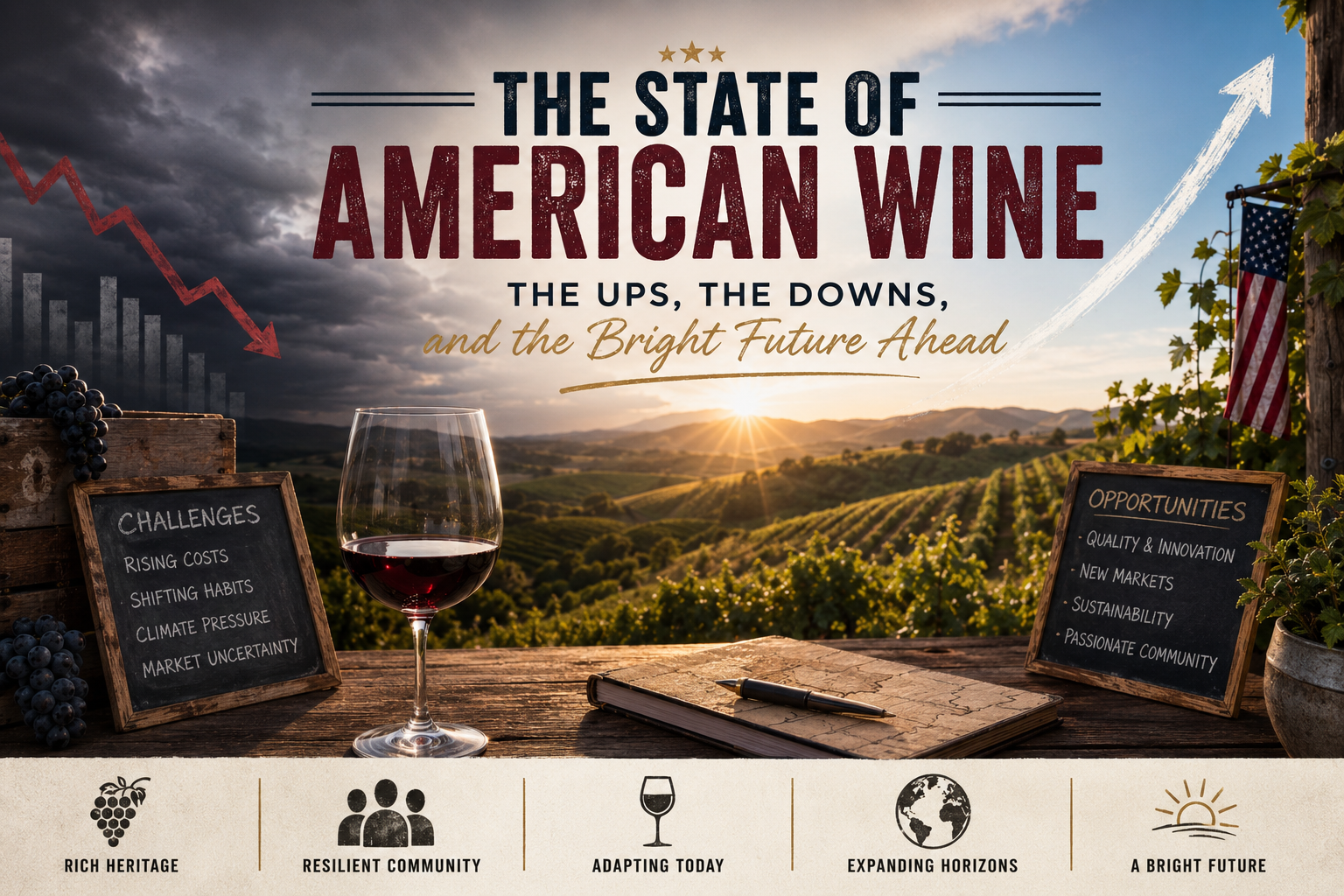
There has never been a more complicated time to love American wine — and I mean that as a compliment.
The industry is navigating genuine headwinds: a generation of younger drinkers who are reaching for canned cocktails and non-alcoholic alternatives, a post-pandemic hangover in direct-to-consumer sales, and a climate that is rewriting the rulebook on where and how grapes can be grown. None of that is small. None of it is going away.
And yet. Walk into any serious wine shop in 2026 and you will find American bottles that can hold their own against the best in the world. Growers in places nobody took seriously a decade ago — the Finger Lakes, the Texas Hill Country, the Shenandoah Valley — are making wines of genuine distinction. The conversation about what American wine can be has never been more interesting.
So where do things actually stand? Let me give you the honest picture.
The Headwinds Are Real
Let's not sugarcoat it. The American wine industry is dealing with a structural shift in drinking culture that no amount of marketing is going to reverse overnight.
Per-capita wine consumption in the United States has been declining since 2022. The culprits are well-documented: Gen Z drinks less alcohol overall, the ready-to-drink category has exploded, and the wellness movement has made "I don't really drink" a socially acceptable answer at a dinner party in a way it simply wasn't ten years ago.
For the big producers — the ones whose business model depends on moving millions of cases of $15 Cabernet — this is an existential challenge. You are seeing it in the numbers. Wholesale inventories are bloated. Tasting room traffic at many Napa estates is down from its post-pandemic peak. Some well-known labels have quietly cut production.
The direct-to-consumer channel, which was the salvation story of the pandemic years, has also cooled. Consumers who signed up for wine clubs in 2020 out of boredom have been quietly canceling. Shipping regulations remain a patchwork nightmare — there are still states where a small producer in Oregon cannot legally mail you a bottle of wine. That is absurd, and it continues to cost the industry real money.
Climate is the other unavoidable conversation. Wildfire smoke taint has become a recurring nightmare in California. The 2020 vintage was largely a write-off for many North Coast producers. The 2022 and 2024 seasons brought their own challenges. Growers who have farmed the same land for generations are being forced to rethink everything — irrigation, harvest timing, varietal selection. Some are planting at higher elevations. Some are looking at entirely different grapes.
Where the Excitement Lives
Here is the thing about headwinds: they tend to separate the committed from the casual. And what is left standing in American wine right now is genuinely exciting.
California is still the center of gravity, but the most interesting work is happening away from the trophy estates. The Sta. Rita Hills, the Sonoma Coast, the Santa Cruz Mountains — these are places where small producers are making Pinot Noir and Chardonnay with a precision and restraint that would have seemed almost un-Californian fifteen years ago. The era of the 15.5% alcohol, heavily extracted, oak-bomb California red is not dead, but it is no longer the only story. Producers like Littorai, Keplinger, and RAEN are making wines that are genuinely world-class by any standard.
Washington State continues to be one of the most undervalued wine regions on the planet. The Columbia Valley's combination of intense summer heat, cold nights, and volcanic soils produces red wines — particularly Cabernet Sauvignon and Syrah — with a structure and longevity that rivals Bordeaux and the Northern Rhône at a fraction of the price. Quilceda Creek and Horsepower are making wines that belong in any serious cellar. The rest of the world just hasn't fully caught on yet.
Oregon's Willamette Valley has matured into a genuine world-class Pinot Noir region. The debate is no longer whether Oregon Pinot can compete with Burgundy — it can, and it does. The debate now is about which sub-AVAs and which producers are defining the next chapter. The Chehalem Mountains, Ribbon Ridge, and Dundee Hills are producing wines with distinct, identifiable terroir. That is a sign of a region that has arrived.
The Finger Lakes is the story I find most compelling right now. Dr. Konstantin Frank's legacy looms over the region, but a new generation of producers is pushing well beyond Riesling — which remains the region's calling card — into Blaufrankisch, Saperavi, Cabernet Franc, and serious red blends. The climate, which was once considered a liability, is increasingly an asset as warming temperatures elsewhere make cool-climate viticulture more valuable. The wines coming out of the Finger Lakes in 2023 and 2024 are the best the region has ever produced.
Emerging regions are the most fun part of the story. Virginia's Monticello AVA is producing Cabernet Franc and Petit Verdot that would surprise anyone who hasn't been paying attention. Texas Hill Country is finding its footing with Tempranillo and Mourvèdre. Michigan's Old Mission and Leelanau peninsulas are making Riesling and Pinot Gris that punch well above their weight. The map of serious American wine is expanding, and that is genuinely good for everyone.
The Varietal Conversation Is Getting More Interesting
One of the most encouraging trends in American wine right now is the growing willingness to move beyond the international varieties that dominated the last fifty years.
For decades, American wine was essentially a Cabernet-Chardonnay-Merlot story with Pinot Noir and Zinfandel as supporting characters. That is changing. Growers are planting Grüner Veltliner in Oregon, Albariño in California, Blaufrankisch in New York, Tannat in Virginia, and Vermentino in Texas. Some of this is climate-driven pragmatism — certain varieties simply handle heat and drought better than Cabernet. But a lot of it is genuine curiosity and ambition.
The natural wine movement, whatever you think of its more extreme expressions, has been a net positive for American wine culture. It has pushed producers to think harder about farming, to reduce intervention in the cellar, and to make wines that actually taste like somewhere. The best American natural wines are genuinely exciting. The worst are undrinkable. But the conversation they have sparked about what wine should taste like has been valuable.
The Price Problem
I want to be honest about something that doesn't get discussed enough: American wine has a price problem at both ends of the market.
At the top, the trophy Napa Cabernets have become almost comically expensive. Bottles that cost $150 a decade ago now cost $350. Some of them are worth it. Many are not. The cult wine market has become increasingly disconnected from what is actually in the glass and increasingly driven by allocation scarcity and social signaling. That is not healthy for the culture.
At the bottom, the race to the floor on $10 and $12 bottles has produced a lot of industrial wine that does the category no favors. When someone's first experience with American Chardonnay is a heavily oaked, sweetened, mass-produced bottle, they are not going to come back for more.
The sweet spot — the $20 to $50 range where you can find genuinely interesting, terroir-driven American wine — is actually very good right now. Better than it has ever been. The challenge is getting people to look there.
The Bright Future
I am genuinely optimistic about where American wine is headed, and here is why.
The talent level among young American winemakers is extraordinary. The generation now coming into their own — many of them trained in Burgundy, the Rhône, or Barossa before coming home — are making wines with a sophistication and sense of place that the previous generation rarely achieved. They are farming better, intervening less, and thinking harder about what their specific piece of ground is trying to say.
The regional diversity is a massive long-term asset. No other wine-producing country in the world has the geographic and climatic range that the United States does. From the cool maritime fog of the Sonoma Coast to the high desert of the Texas Hill Country to the glacial lake influence of the Finger Lakes, American wine can offer something for every palate and every occasion. That story is still being written.
And the consumers who are still engaged with wine — who are seeking it out, learning about it, traveling to wine regions — are more knowledgeable and more curious than ever. The casual drinker may be drifting away, but the committed wine lover is more committed than ever. That is the audience worth making wine for.
The Bottom Line
American wine in 2026 is not without its problems. The industry faces real structural challenges that are going to require real adaptation. Some producers will not make it through. Some regions will struggle.
But the wines being made right now — by the right producers, in the right places, with the right intentions — are as good as American wine has ever been. The Finger Lakes is having a moment. Washington is criminally underrated. California's best producers are making wines of genuine world-class distinction.
The story of American wine is still being written. And from where I sit, the most interesting chapters are still ahead.
Explore Topics
Written by
Chuck Hoeffler
Chuck Hoeffler is the founder and editor of The American Vine. He loves tasting and writing about American wine, with a particular focus on regions and wineries that deserve more attention than they typically receive.


