
Hybrid American Wine Grapes: The Grapes Helping Build the Future of American Wine
Mention America's great wine grapes and most people immediately think of Cabernet Sauvignon, Chardonnay and Pinot Noir. But travel beyond America's most famous wine regions and another group of grapes begins appearing on tasting-room menus — Chambourcin, Marquette, Frontenac, La Crescent, Traminette. These hybrid wine grapes are helping rewrite the map of American wine.
When most wine drinkers think about America's great wine grapes, familiar names immediately come to mind: Cabernet Sauvignon, Chardonnay, Pinot Noir, Riesling, Merlot and Sauvignon Blanc. These European varieties have produced many of America's greatest wines and will continue to play an enormous role in the country's wine industry.
But travel beyond America's most famous wine regions and you'll begin encountering a very different collection of names. Marquette, Frontenac, Chambourcin, Traminette, La Crescent, Seyval Blanc, Chardonel, Itasca and Aravelle may not have the instant recognition of Cabernet Sauvignon or Chardonnay, but these grapes are becoming increasingly important to the future of American wine.
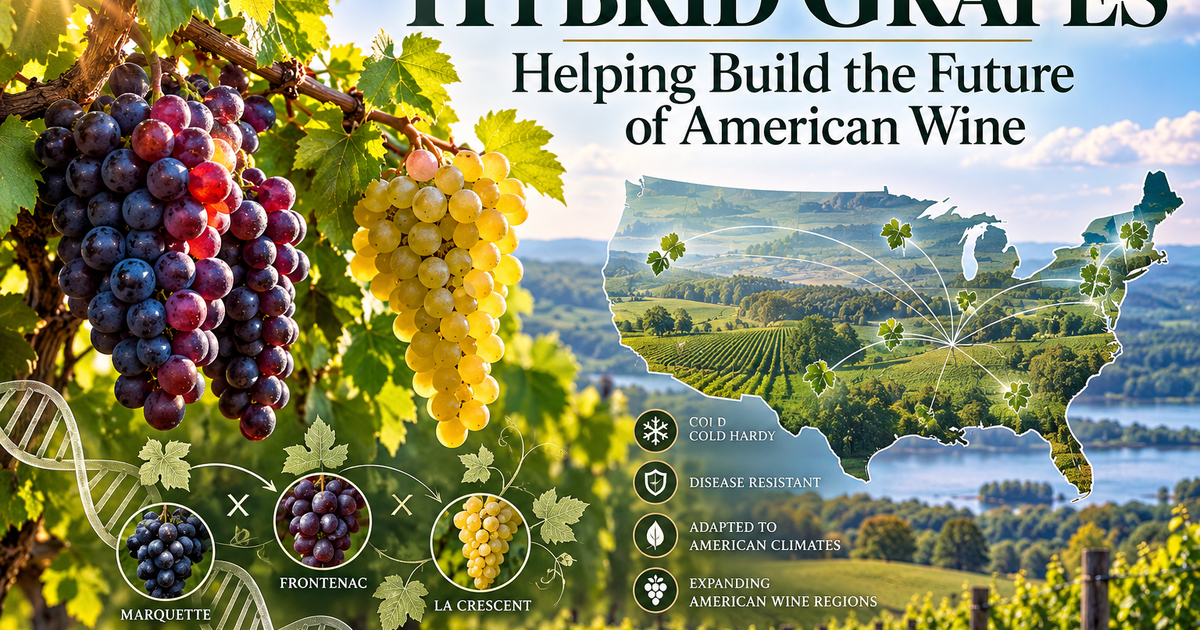
They are part of the fascinating world of hybrid wine grapes — grapes developed by crossing different grape species or existing hybrids in an effort to combine desirable characteristics. Some have been bred to survive bitterly cold winters. Others provide improved resistance to fungal diseases. Still others combine these agricultural advantages with increasingly impressive wine quality.
Hybrid grapes are one of the reasons commercial winegrowing has expanded into places such as Minnesota, Wisconsin, Vermont, Iowa, Nebraska and other parts of the United States where traditional European wine grapes can be challenging to grow. They are also attracting greater attention in humid eastern and Midwestern regions, where disease pressure can make conventional viticulture difficult and expensive.
For decades, hybrids were sometimes treated as second-class grapes — a compromise for regions unable to grow the supposedly "real" wine grapes of Europe. That attitude is rapidly becoming outdated. Today's best hybrids aren't simply grapes capable of surviving difficult conditions. Increasingly, they are grapes capable of producing distinctive, high-quality wines while doing so.
And that could make them one of the most important developments in the next chapter of American wine.
What Exactly Is a Hybrid Wine Grape?
To understand hybrid grapes, it helps to remember that not all grapevines belong to the same species. Most of the world's famous wine grapes — including Cabernet Sauvignon, Chardonnay, Pinot Noir, Riesling, Syrah and Merlot — belong to the European species Vitis vinifera.
Vitis vinifera has extraordinary winemaking qualities, which helps explain why these grapes have spread around the world. But North America has its own native grape species, including Vitis riparia, Vitis labrusca, Vitis aestivalis and Vitis rupestris, among others.
Over thousands of years, these native American grape species evolved under North American environmental conditions. Some developed remarkable winter hardiness. Others developed useful resistance or tolerance to diseases and pests. Certain species can survive conditions that would severely damage or kill many traditional European wine grapes.
The challenge is that native American grapes don't necessarily possess all the flavor, aroma and structural characteristics winemakers want. That led grape breeders to an intriguing idea: What if the wine quality associated with European grapes could be combined with the toughness of American grapes?
That question helped launch generations of hybrid grape breeding.
How Are Hybrid Wine Grapes Developed?
Developing a hybrid grape begins with something relatively straightforward: crossing two selected grapevines. The science and patience required afterward, however, are anything but simple.
A breeder might begin with one grape that produces excellent wine but struggles with winter temperatures. Another vine might possess tremendous cold hardiness but produce fruit with less desirable wine characteristics. By crossing those vines, researchers hope that at least some of their offspring will inherit desirable qualities from both parents.
During flowering, pollen from one selected vine is used to pollinate another. The resulting grapes contain seeds, and those seeds are planted. Each seed produces a genetically unique vine.
This is important because grape breeding isn't like making a photocopy. Two seedlings produced from the same parents can behave very differently, just as brothers and sisters can inherit different combinations of characteristics from their parents.
One seedling might survive winter beautifully but produce poor wine. Another may develop delicious fruit but prove extremely susceptible to disease. One might ripen too late, another might have excessive acidity, and another might simply produce too little fruit to be commercially useful.
Then, occasionally, researchers find something exceptional.
That's when the long process of testing really begins.
Developing a New Grape Can Take Decades
One of the most remarkable things about grape breeding is the amount of time required.
Researchers don't simply grow a vine for two years, taste the grapes and release a new variety. A potential wine grape must survive repeated growing seasons, winters, disease outbreaks and changing weather conditions. Researchers need to understand how consistently it produces fruit, when it ripens, how vulnerable it is to disease and, most importantly, what kind of wine it can make.
The University of Minnesota notes that promising grape selections are generally evaluated for 15 years or more before being considered for release. The cross that eventually became Marquette was made in 1989, but Marquette wasn't commercially introduced until 2006.
Cornell University's Aravelle provides an even more extraordinary example. The white grape originated from a 1981 cross between Cayuga White and Riesling. Cornell officially released Aravelle in 2023 — approximately 42 years after the original cross was made.
Think about that the next time you encounter an unfamiliar grape at an American winery. Behind that bottle could be several decades of research, vineyard trials and experimental winemaking.
What Are Grape Breeders Looking For?
Survival is only one part of the equation. Modern grape breeders are trying to create vines that work for growers, winemakers and consumers simultaneously.
Cold hardiness can be critically important in northern regions because winter temperatures can severely injure traditional European grapevines. Disease resistance is another major consideration, particularly in humid areas where powdery mildew, downy mildew, black rot and bunch rot can create enormous vineyard challenges.
Researchers also examine when the grapes ripen, how much sugar they accumulate, their acidity, crop yields, vine vigor and cluster structure. Loosely packed grape clusters, for example, may dry more easily after rain and therefore experience less rot than extremely compact clusters.
But agricultural performance isn't enough. Ultimately, someone has to want to drink the wine.
That means breeders and university enology programs make experimental wines from promising selections. Researchers evaluate aroma, flavor, acidity, tannins, color and overall wine quality. They may also experiment with fermentation temperatures, yeast strains, oak aging and other winemaking techniques.
The goal has evolved beyond simply asking, "Can this grape grow here?"
Today's much more important question is: "Can this grape grow successfully here and produce excellent wine?"
Why Hybrid Grapes Matter So Much to American Wine
America's geography is enormous, and its wine regions experience dramatically different growing conditions. Napa Valley bears little resemblance to Minnesota. The Finger Lakes aren't Texas. Vermont isn't Virginia, and Michigan certainly isn't Arizona.
Traditional Vitis vinifera grapes perform beautifully in many American wine regions, but trying to force Cabernet Sauvignon, Chardonnay or Pinot Noir into every vineyard doesn't always make agricultural or economic sense.
Hybrid grapes give growers another option. Rather than forcing a vineyard environment to accommodate a grape poorly suited to it, breeders can develop grapes better suited to the environment.
That seemingly simple idea has helped dramatically expand the geography of American wine.
The University of Minnesota and America's Cold-Climate Wine Revolution
Few institutions demonstrate the potential of hybrid grapes better than the University of Minnesota.
Minnesota is hardly an obvious place to build a wine industry. Winter temperatures can fall far below zero, conditions that can severely damage many traditional European wine grapes. Native northern grape species, however, possess remarkable cold tolerance.
Researchers at the University of Minnesota used those cold-hardy genetics as part of a breeding program designed to create grapes capable of surviving northern winters while producing increasingly sophisticated wines.
The results include varieties that have become foundational to cold-climate American wine: Frontenac, Frontenac Gris, Frontenac Blanc, La Crescent, Marquette and Itasca, along with newer releases.
These grapes haven't merely created interesting new bottles. They've helped make commercial winegrowing possible across parts of the northern United States that once seemed extraordinarily difficult for serious viticulture.
Frontenac: Helping Open America's Northern Wine Frontier
Frontenac became one of the foundational grapes of America's cold-climate wine movement. The University of Minnesota developed it to combine exceptional winter hardiness with strong vineyard performance and useful disease resistance.
Frontenac can produce deeply colored wines showing black cherry, blackberry, plum, dark berries and spice. Its naturally high acidity can present challenges to winemakers, but skilled producers have learned how to work with the variety in dry reds, rosés, fortified wines and other styles.
Perhaps Frontenac's greatest contribution, however, wasn't simply flavor. It demonstrated that vineyards in extremely cold regions didn't necessarily need to accept massive winter damage as an unavoidable part of growing wine grapes.
Frontenac was eventually joined by color mutations Frontenac Gris and Frontenac Blanc, expanding the family into white and rosé wine production.
Together, these grapes have become closely associated with northern American wine.
Marquette: Moving Beyond Survival
If Frontenac helped prove that northern winegrowing was possible, Marquette helped change expectations about what cold-hardy red wine could become.
The University of Minnesota made the cross that produced Marquette in 1989 and released the grape commercially in 2006. Marquette combines remarkable cold hardiness with the potential to produce attractive dry red wines featuring cherry, blackberry, plum, pepper, spice and earthy characteristics.
Depending on vineyard conditions and winemaking, Marquette can produce lighter, fruit-driven reds or more structured wines incorporating barrel aging.
Its importance extends beyond Minnesota. Marquette has spread into vineyards across several northern states, giving growers a red wine grape capable of handling conditions that would be extremely challenging for Cabernet Sauvignon, Merlot or even Pinot Noir.
Marquette helped change the hybrid conversation from "Can we make wine here?" to "How good can the wine become?"
That's a much more exciting question.
La Crescent: An Aromatic White With Its Own Personality
La Crescent demonstrates why hybrid grapes shouldn't simply be viewed as substitutes for European varieties.
This cold-hardy white grape can produce intensely aromatic wines showing peach, apricot, citrus, pineapple, flowers and tropical fruit. Depending on the producer, La Crescent can be made into dry, off-dry or sweeter styles.
Its expressive personality gives northern wineries something especially valuable: a grape with its own identity.
Instead of attempting to make a northern Chardonnay taste like California Chardonnay, growers can produce a wine that expresses something unique to their region.
That's ultimately how emerging wine regions become interesting.
Itasca and the Next Generation of Cold-Hardy Grapes
Itasca represents another step in the evolution of American hybrid breeding.
Some earlier cold-hardy grapes naturally produce very high acidity, which can present challenges for winemakers. Researchers therefore sought varieties that retained exceptional cold tolerance while providing fruit chemistry that was easier to balance in the winery.
Itasca was developed with lower acidity and good sugar levels while maintaining impressive winter hardiness and useful resistance to several vineyard problems, including powdery mildew, downy mildew and phylloxera.
That combination demonstrates how sophisticated modern breeding has become. The objective is no longer simply producing vines tough enough to survive a Minnesota winter. Researchers are refining grapes to make them increasingly practical in the vineyard and increasingly attractive in the glass.
Cornell University and the Development of Eastern American Wine Grapes
The University of Minnesota isn't alone in reshaping American wine.
Cornell University has played an enormous role in developing grapes for New York and other eastern and Midwestern wine regions. Cornell releases include Cayuga White, Chardonel, Traminette, Noiret, Corot Noir, Aromella, Arandell and Aravelle.
These grapes represent different attempts to solve the complex equation facing eastern winegrowers: produce high-quality wine while dealing with cold winters, humid summers, fungal diseases and other environmental pressures.
Traminette: A Hybrid Wine Drinkers Can Immediately Understand
Traminette may be one of the easiest hybrid grapes to introduce to consumers because its aromatic personality is immediately recognizable.
Released by Cornell in 1996, Traminette has Gewürztraminer in its family tree. That heritage becomes apparent in wines that can offer aromas and flavors of rose petals, orange blossom, peach, apricot, lychee, citrus, tropical fruit and spice.
For wine drinkers who enjoy Gewürztraminer, Riesling or Viognier, Traminette can be an easy introduction to hybrid wine.
More importantly, it demonstrates that hybrids don't have to taste rustic, strange or inferior. A well-made Traminette can be beautifully aromatic, refreshing and sophisticated.
It has become an increasingly important grape in states including Indiana, Illinois, Ohio and other parts of the Midwest and East.
Chardonel: Combining Chardonnay With Adaptability
Chardonel provides another fascinating example of what breeders are trying to accomplish. It resulted from a cross between Seyval Blanc and Chardonnay.
The concept is easy to understand: combine some of Chardonnay's desirable wine characteristics with useful traits inherited through Seyval.
Chardonel can produce wines showing apple, pear, citrus, melon and tropical fruit, and it can respond well to barrel fermentation and oak aging.
For emerging wine regions, that provides an opportunity to produce a familiar style of dry white wine using a grape that may be better suited to local growing conditions than Chardonnay itself.
Chambourcin: One of America's Most Important Hybrid Reds
Among the French-American hybrids, Chambourcin has become one of the most recognizable names in American vineyards.
It is grown across numerous eastern, southern and Midwestern states and has demonstrated an ability to produce deeply colored wines with flavors of black cherry, blackberry, raspberry, plum, pepper, herbs and spice.
Chambourcin's naturally bright acidity also makes it useful for rosé production, while careful vineyard management and winemaking can produce serious dry reds.
The grape is particularly important because it challenges one of the wine world's persistent assumptions: that unfamiliar automatically means inferior.
A Chambourcin shouldn't be judged by whether it tastes exactly like Cabernet Sauvignon. Marquette doesn't need to taste exactly like Pinot Noir, and La Crescent doesn't need to imitate Chardonnay.
These grapes deserve to be judged on their own terms.
American wine becomes much more interesting when every region isn't attempting to reproduce the same European varieties.
Seyval Blanc: A Hybrid That Helped Build Other Hybrids
Seyval Blanc has long been planted across parts of the eastern and Midwestern United States. It can produce crisp white wines with flavors of green apple, citrus, pear, melon and mineral notes.
But Seyval's importance extends beyond the wines bottled under its own name. It has also played a significant role as breeding material.
Cornell's Cayuga White, for example, resulted from Seyval crossed with Schuyler, while Chardonel resulted from Seyval crossed with Chardonnay.
This demonstrates something fascinating about grape breeding: a successful hybrid isn't necessarily the end of the story.
It can become the parent of another grape, which can then become a parent itself.
Hybrid grape development is therefore an ongoing process of refinement spanning generations.
Aravelle: More Than Four Decades in the Making
Few grapes demonstrate the extraordinary patience required in breeding better than Aravelle.
Cornell grape breeder Bruce Reisch made the original cross between Cayuga White and Riesling in 1981. Cornell didn't officially release the variety until 2023.
During those decades, researchers studied how the vine performed, how it responded to disease, how its fruit ripened and, importantly, what kind of wine it produced.
Aravelle combines useful characteristics inherited from Cayuga White with the recognized wine-quality potential of Riesling. Cornell researchers have highlighted its improved resistance to several rot and fungal disease problems compared with Riesling while maintaining attractive wine characteristics.
This is where modern hybrid breeding becomes especially interesting. Researchers aren't simply trying to create indestructible vines. They're attempting to combine wine quality, regional character and agricultural resilience in the same grape.
Hybrid Grapes and the Battle Against Vineyard Disease
Disease resistance could become one of the biggest reasons hybrid grapes matter to American wine.
Grapevines can be vulnerable to powdery mildew, downy mildew, black rot, Botrytis bunch rot and numerous other vineyard problems. In humid regions, controlling these diseases can require substantial labor and repeated vineyard treatments.
Traditional European varieties can be particularly vulnerable to certain diseases. Hybrid breeding allows researchers to incorporate genetic resistance or tolerance from other grape species.
That doesn't mean hybrid vineyards require no spraying or disease management. They absolutely do, and different varieties possess very different levels of resistance.
But greater natural resistance can potentially reduce disease pressure and provide growers with another tool for managing their vineyards.
Could Hybrid Grapes Make American Wine More Sustainable?
Wine sustainability involves far more than whether a vineyard is organic.
Growers need to consider how often tractors travel through vineyards, how much fuel is consumed, how frequently vines require treatments, how much labor is needed, how much fruit is lost to disease and how often winter-damaged vines need to be replaced.
There is also economic sustainability. A vineyard that requires enormous amounts of labor, chemicals and vine replacement may simply become too expensive for a small grower to operate profitably.
A grape naturally adapted to local climate and disease conditions can potentially improve several parts of that equation.
This doesn't mean every hybrid vineyard is automatically sustainable, but it does mean grape genetics deserves a much larger place in conversations about environmentally and economically sustainable winegrowing.
Sometimes one of the most sustainable decisions a farmer can make is simply planting the right grape in the right place.
Climate Change Makes Grape Breeding Even More Important
Winegrowers across the United States are already confronting changing and increasingly unpredictable environmental conditions.
Depending on the region, vineyards may experience hotter growing seasons, extreme heat, drought, heavier rainfall, unpredictable freezes, changing disease pressure and increasingly severe weather events.
Different grape varieties respond differently to those stresses because each carries its own collection of genetic traits.
That makes grape breeding another potential tool for adaptation.
Instead of asking only where America's traditional grapes can continue to grow, researchers can ask a more ambitious question: What grapes should we develop for the vineyards America will have 20, 30 or 50 years from now?
Some of those grapes may already be growing in experimental vineyards.
Hybrid Grapes Are Expanding the Map of American Wine
Perhaps the greatest contribution of hybrid grapes has already happened: they changed American wine geography.
Cold-hardy varieties helped make commercial winegrowing much more practical across the Upper Midwest and northern New England. French-American hybrids have helped eastern and Midwestern wineries deal with humidity, disease and other environmental pressures.
The University of Minnesota explicitly credits cold-hardy grape development with helping establish and expand northern wine industries. Today, travelers encounter serious local wine industries in Minnesota, Wisconsin, Iowa, Nebraska, Vermont, New Hampshire, Maine and other states that previous generations rarely associated with vineyards.
Hybrid grapes haven't merely created new wines. They've helped create new wine regions.
And they give those regions something else: the opportunity to develop their own identities.
A winery planting Marquette, Chambourcin or Traminette isn't simply competing with Napa Valley, Bordeaux or the Willamette Valley. It's producing something that belongs to its own place.
Wine tourism thrives on discovery. Travelers don't necessarily want every region to taste identical. Hybrid grapes can give emerging American wine regions something genuinely their own.
The Next Generation of American Wine Grapes
Today's grape breeders have scientific tools that previous generations could barely have imagined. Traditional crossing and vineyard evaluation remain essential, but researchers can now combine those techniques with genetic analysis, sophisticated chemical testing and other technologies that help identify promising vines more efficiently.
None of this eliminates the need for patience. A computer can't tell researchers everything about how a vine will perform through fifteen winters, and genetic analysis can't replace tasting the resulting wine.
The vineyard remains the ultimate laboratory.
But modern science gives breeders increasingly powerful ways to identify which seedlings deserve further investigation.
The result should be better grapes — varieties designed not merely for survival, but for the realities of modern American winegrowing.
Hybrid Grapes Every American Wine Lover Should Try
For wine drinkers interested in exploring hybrids, there has never been a better time to start.
For reds, look for: Marquette, Chambourcin, Frontenac, Noiret, Corot Noir, Baco Noir and Petite Pearl. Each offers a different expression, ranging from juicy and fruit-driven to dark, spicy and structured.
For whites, seek out: Traminette, La Crescent, Seyval Blanc, Chardonel, Itasca, Frontenac Gris, Frontenac Blanc, Cayuga White, Aromella and Aravelle.
Don't worry if you've never heard of some of these grapes.
That's part of what makes exploring American wine so exciting.
Twenty years from now, some of these names may seem considerably less unusual.
Hybrid Grapes and the Future of American Wine
Hybrid grapes aren't going to replace Cabernet Sauvignon, and they don't need to. Chardonnay isn't disappearing. Pinot Noir isn't going anywhere, and Riesling remains one of America's great white wine grapes.
The importance of hybrids is that they expand the possibilities.
They allow northern growers to produce wine despite brutal winters. They give humid eastern vineyards alternatives to highly disease-sensitive European varieties. They provide emerging regions with distinctive grapes around which they can build their own identities. They give researchers new tools for addressing climatic stress and disease pressure.
Most importantly, they are becoming increasingly capable of producing wines that deserve to be taken seriously on their own terms.
Somewhere in an American research vineyard today, there may be an unnamed grapevine known only by a number. Researchers may be watching to see whether it survives another winter, measuring its disease resistance, testing its fruit chemistry and fermenting a few gallons of experimental wine.
Most of those experimental vines will never receive names.
But one might.
Twenty years from now, that grape could be planted across thousands of acres. It could become the signature variety of an emerging American wine region. It might help farmers reduce vineyard inputs, survive a changing climate or establish vineyards in places we currently consider marginal wine country.
Someday, wine drinkers may order a bottle made from that grape without giving its once-unusual name a second thought.
That's what makes hybrid grapes so fascinating. They aren't merely an interesting footnote in American wine history.
They are helping determine what American wine will become next.
Related reading: The Northeast Wine Frontier · Finger Lakes Wine Guide · Virginia Wine Guide · How to Taste Wine · What Is Terroir?
Explore Topics
Written by
The American Vine
Chuck Hoeffler is the founder and editor of The American Vine. He loves tasting and writing about American wine, with a particular focus on regions and wineries that deserve more attention than they typically receive.


