
Could the Northeast Become America's Next Great Wine Frontier?
From the Finger Lakes to New England, the Northeast is quietly building one of the most diverse and exciting wine cultures in America. Could it become the country's next great wine frontier?
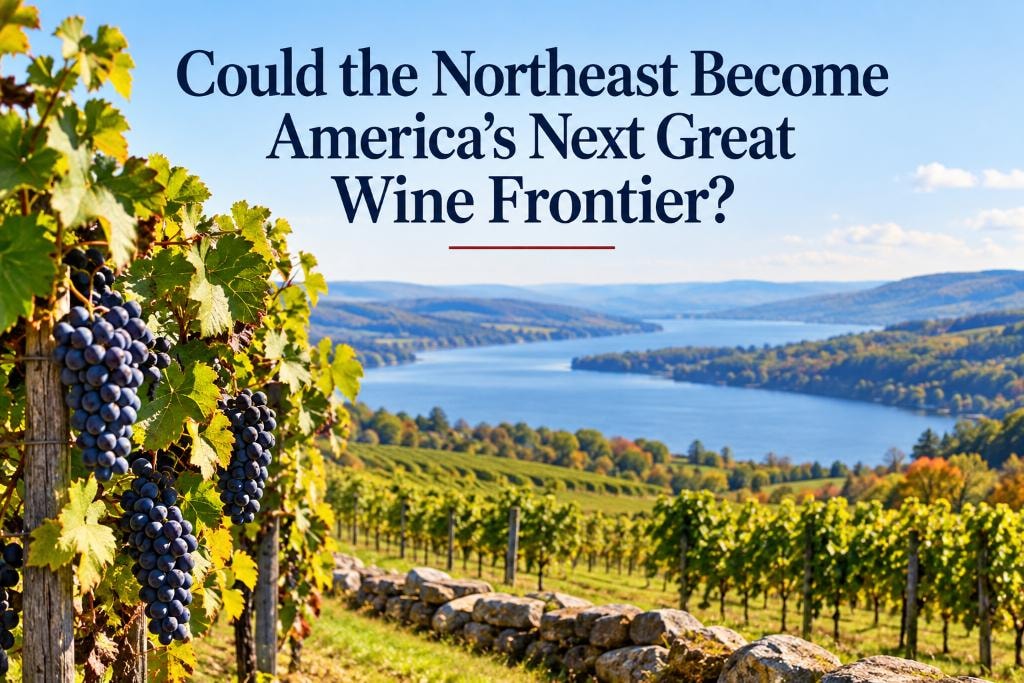
For generations, when Americans thought about serious American wine, their attention naturally turned west. California built the country's international wine reputation, Oregon became synonymous with Pinot Noir, and Washington State established itself as one of America's great regions for Cabernet Sauvignon, Syrah and Riesling.
But another American wine story has quietly been developing thousands of miles away. From the shores of New York's Finger Lakes and the vineyards of Long Island to the rolling hills of New Jersey and Pennsylvania, through Virginia's Blue Ridge foothills and north into New England, an enormous and remarkably diverse collection of wine regions is beginning to find its identity.
The Northeast may never look or taste like California wine country — and that may be exactly the point. At The American Vine, we believe the Northeast has the ingredients to become one of the most fascinating wine frontiers in America, not by copying Napa or Sonoma, but by discovering which grapes, styles and traditions truly belong in the East.
A Wine Region Much Bigger Than Most Americans Realize
There isn't really a single "Northeastern wine region." Instead, there is a patchwork of dramatically different growing areas stretching hundreds of miles, each with its own soils, climate, grapes and challenges.
New York alone illustrates this diversity. The state includes the cool Finger Lakes, maritime-influenced Long Island, historic Hudson Valley vineyards, the Lake Erie grape belt, the Niagara Escarpment and increasingly interesting cold-climate vineyards farther north. More than 100 grape varieties are grown across the state, ranging from familiar European wine grapes to native American varieties and modern hybrids.
Move south and the landscape changes again. New Jersey combines the cooler hills of the north with the sandy, maritime-influenced vineyards of the Outer Coastal Plain farther south. Pennsylvania stretches from the Lake Erie shoreline to southeastern vineyards influenced by an entirely different climate. Virginia adds elevation, rolling Piedmont landscapes and the Blue Ridge Mountains. Continue north into New England and growers encounter shorter growing seasons and colder winters, but they also have access to an increasingly impressive collection of cold-hardy grapes.
There isn't one Northeast terroir. There are dozens, and that diversity could ultimately become one of the region's greatest advantages.
New York Has Already Proven Eastern Wine Can Be World-Class
Any discussion of the Northeast's wine potential should begin with New York. The Finger Lakes has become one of America's most respected cool-climate wine regions, particularly for Riesling. Deep lakes such as Seneca, Cayuga and Keuka help moderate temperatures around nearby vineyards, reducing some of the extremes that would otherwise make grape growing considerably more difficult.
Riesling, however, is only part of the story. Cabernet Franc has become increasingly important, while Chardonnay, Gewürztraminer, Pinot Noir and sparkling wines continue to develop. Producers are also experimenting with hybrid and native varieties, giving the region a remarkably broad wine culture.
Long Island offers a completely different expression of New York wine. Its maritime climate has helped growers work successfully with Merlot, Cabernet Franc, Chardonnay, Sauvignon Blanc and other vinifera varieties. The important lesson isn't that every Northeastern region should imitate the Finger Lakes or Long Island. It's that New York has demonstrated something fundamental: fine American wine doesn't have to come from the West Coast.
New Jersey May Be One of the Northeast's Most Underrated Wine States
New Jersey rarely receives the attention it deserves in the national wine conversation. Yet the state contains several federally recognized American Viticultural Areas, including Warren Hills, the Outer Coastal Plain and the Central Delaware Valley, along with the Cape May Peninsula AVA nested within the Outer Coastal Plain.
These regions can be dramatically different from one another. Northern New Jersey's hills, elevations and cooler conditions offer a very different growing environment from the sandy soils and maritime influences farther south. That diversity allows growers to experiment with an unusually broad selection of grapes.
Cabernet Franc, Cabernet Sauvignon, Chardonnay and Riesling can be found alongside Chambourcin and other hybrid varieties. More importantly, New Jersey's wine industry appears increasingly willing to search for its own identity rather than simply copying better-known regions.
The question is no longer simply whether New Jersey can make good wine. The more interesting question is becoming: What kinds of wine can New Jersey make exceptionally well? That is a much more exciting conversation and one that could shape the state's wine industry over the coming decade.
Pennsylvania Connects Two Very Different Wine Worlds
Pennsylvania occupies a fascinating position in Eastern wine. Its northwestern vineyards are connected to the enormous Lake Erie grape-growing region shared with New York. Historically, much of that acreage has been associated with Concord grapes and the juice industry, giving the area a very different agricultural heritage from many traditional fine-wine regions.
Pennsylvania wine, however, is much broader than Concord. The state's southeastern and central vineyards offer opportunities for vinifera and hybrid wine grapes, including Cabernet Franc, Chardonnay, Riesling, Chambourcin and many others.
Pennsylvania also illustrates one of the great challenges facing Eastern grape growers. Growing grapes isn't enough; regions need profitable markets for those grapes. Changing demand for traditional varieties is encouraging growers and wineries to think differently about what they plant, what styles of wine they produce and how they attract consumers.
That pressure can be painful, but it can also encourage experimentation. Some of the most interesting chapters in American wine have begun when growers realized that the grapes of yesterday might not necessarily be the grapes of tomorrow.
Virginia Is Becoming an Eastern Wine Powerhouse
Depending on where you draw the geographic line, Virginia is usually considered Mid-Atlantic rather than Northeastern. But it belongs in this broader Eastern wine conversation because it demonstrates just how rapidly a once-overlooked American wine region can evolve.
Virginia now has hundreds of wineries and thousands of acres of vineyards. More importantly, it is developing a recognizable identity. Cabernet Franc has emerged as one of its signature red varieties, while Petit Manseng has become one of its most intriguing white grapes, capable of producing dry, off-dry and sweet wines. Chardonnay, Merlot, Viognier and other varieties contribute to an increasingly diverse wine culture.
The significance of Virginia goes beyond the number of wineries or acres planted. The state demonstrates what can happen when growers stop trying to determine whether their region can imitate California or Europe and instead begin identifying the grapes and styles that consistently perform well in their own climate.
That is exactly the type of evolution the rest of the East needs.
New England and the Rise of Cold-Hardy Grapes
If Virginia demonstrates what can happen at the warmer end of Eastern wine country, New England represents the opposite extreme. Massachusetts, Connecticut, Rhode Island, Vermont, New Hampshire and Maine face conditions that historically made commercial winegrowing with traditional European varieties extremely challenging.
This is where one of the most important developments in modern American wine enters the story: cold-hardy hybrid grapes.
Varieties developed specifically to tolerate severe winter temperatures are allowing vineyards to thrive in places that previous generations of growers might have considered far too risky. Grapes such as Marquette, La Crescent, Frontenac, Frontenac Gris and Itasca are expanding the possibilities for northern vineyards.
These grapes shouldn't necessarily be viewed as substitutes for Cabernet Sauvignon, Chardonnay or Pinot Noir. They offer something potentially much more interesting — the opportunity to create a distinctive Northern American wine culture.
The future of Maine or Vermont wine probably isn't about producing an imitation of Napa Cabernet. It may be about creating wines that could logically come from nowhere else but Maine or Vermont.
Hybrid Grapes Could Change the Northeast
For decades, hybrid grapes suffered from an image problem. Many serious wine drinkers viewed Vitis vinifera — the European species that includes Cabernet Sauvignon, Chardonnay, Pinot Noir and Riesling — as inherently superior. Hybrids were frequently treated as second-class grapes suitable primarily for regions where the "real" wine grapes couldn't survive.
That attitude is increasingly outdated. Modern grape breeding isn't simply about creating vines capable of surviving cold winters. Researchers and breeders are working toward combinations of wine quality, cold tolerance, disease resistance and greater environmental sustainability.
This doesn't mean Cabernet Franc, Riesling or Chardonnay are disappearing from the Northeast. Quite the opposite. The region's most interesting future may involve vinifera and hybrid grapes growing alongside one another.
A Finger Lakes producer might specialize in Riesling while experimenting with hybrids. A New Jersey winery could produce Cabernet Franc alongside Chambourcin. A Vermont winery might build much of its identity around cold-hardy varieties. There doesn't need to be one solution for the entire Northeast because there isn't one Northeast climate.
Climate Change Brings Opportunity — and Serious Risks
It's tempting to assume that a warming climate automatically benefits Northern wine regions. The reality is considerably more complicated. Warmer growing seasons can help grapes achieve greater ripeness, and some areas have experienced improved conditions for varieties that once struggled to ripen consistently.
But warmer temperatures bring new problems as well. Warmer winters can cause vines to leave dormancy earlier, making emerging buds vulnerable to late spring frosts. Growers must also contend with excessive rainfall, humidity, fungal disease, drought, heat waves and increasingly unpredictable weather patterns.
The future isn't as simple as California becoming too hot while New York becomes ideal. Instead, changing conditions may alter which grapes work best in each region. Cabernet Franc may outperform Cabernet Sauvignon in certain areas. Disease-resistant hybrids may become increasingly attractive. Vineyard elevation, slope, airflow, soil drainage and proximity to water could become even more important.
Climate change could even create new areas where quality wine grapes become commercially viable while making some existing vineyards more challenging to farm. For Northeastern winegrowers, adaptation will be one of the defining themes of the coming decades.
Water May Be the Northeast's Secret Weapon
Look at a map of Northeastern wine country and one geographical feature quickly becomes apparent: water is everywhere. The Finger Lakes, Lake Erie, Lake Ontario, Long Island Sound, the Atlantic Ocean, the Chesapeake Bay and countless rivers and valleys influence vineyards throughout the region.
Large bodies of water can moderate nearby temperatures, helping reduce extremes and sometimes extending the growing season. In the Finger Lakes, for example, the enormous depth of some lakes helps moderate temperatures in nearby vineyards.
These aren't minor geographical details. They help explain why grapes can succeed in places that might otherwise appear too cold or unpredictable. As growers become more sophisticated about matching individual varieties to specific vineyard sites, these localized climatic influences could become even more important.
Better Winemaking Is Changing Eastern Wine
Better grapes alone don't explain the improving quality of Northeastern wine. The other revolution is happening inside the winery.
Today's Eastern winemakers have access to better vineyard research, improved clones and rootstocks, more precise temperature control, cleaner cellar practices and a growing body of regional experience. Perhaps most importantly, winemakers are learning what not to do.
Trying to force a cool-climate Cabernet Sauvignon into the style of a massive Napa Cabernet doesn't necessarily make sense. Picking earlier, preserving acidity and embracing lighter, fresher styles may produce something far more compelling.
Cabernet Franc doesn't need to become Cabernet Sauvignon. Hybrid grapes don't need to pretend they're Pinot Noir. The Northeast becomes considerably more interesting when its winemakers stop apologizing for their climate and begin using it to create distinctive wines.
Could There Be a Northeastern Wine Style?
Probably not — and that's a good thing.
The Northeast is simply too diverse. A Long Island Merlot shouldn't taste like a Finger Lakes Riesling. A Virginia Petit Manseng shouldn't resemble a Vermont Marquette, and a New Jersey Cabernet Franc doesn't need to imitate either one.
What these wines can share is something broader: freshness, acidity, regional character and a willingness to experiment. That combination could eventually become one of the Northeast's calling cards.
Rather than a single Northeastern style, we could see a family of distinctive regional identities emerge. That is arguably far more interesting than trying to force thousands of miles of vineyards into one definition.
The Northeast Has Another Huge Advantage: Millions of Wine Drinkers
There is one factor in wine development that doesn't receive enough attention: customers.
The Northeast and Mid-Atlantic sit near one of the largest concentrations of consumers in North America. New York City, Boston, Philadelphia, Washington, Baltimore and dozens of other population centers place millions of potential wine drinkers within relatively easy driving distance of vineyards.
That creates enormous possibilities for tasting-room sales and wine tourism. A consumer doesn't necessarily have to fly across the country for a vineyard weekend. For millions of Americans, wine country may be only a few hours — or even less — from home.
That direct connection between winery and consumer could become increasingly valuable, particularly for small wineries that may never have the production or distribution necessary to compete nationally. Instead, they can offer something a supermarket shelf cannot: the opportunity to stand in the vineyard, meet the people making the wine and experience the place where the grapes were grown.
There Are Still Major Obstacles
None of this means the Northeast is destined to become America's next great wine frontier simply because vineyards exist there. The challenges remain substantial.
Unpredictable weather can devastate crops. Humidity and disease pressure can increase vineyard costs. Winter freezes remain dangerous in northern areas. Invasive pests threaten vineyards, land can be expensive near major population centers, and many small wineries struggle to achieve broad distribution.
Perhaps the greatest obstacle, however, is perception. Ask the average American wine drinker to name American wine regions and Napa, Sonoma and perhaps Oregon's Willamette Valley will probably come first. New Jersey, Pennsylvania, Vermont or Connecticut are far less likely to be mentioned.
Changing those perceptions could take years. But the Finger Lakes provides an excellent example of why it is possible. A region that was once largely overlooked by serious wine drinkers has developed an international reputation for Riesling and an increasingly strong reputation for Cabernet Franc and other cool-climate wines.
Stop Trying to Become the Next Napa
There may be an even bigger lesson in all of this: the Northeast doesn't need another Napa Valley. America already has Napa.
What American wine needs is a Finger Lakes that becomes unmistakably Finger Lakes, a Virginia that confidently tastes like Virginia, a New Jersey wine industry that discovers what New Jersey vineyards do best, a Pennsylvania wine culture that embraces its own grapes and landscapes, and a New England wine industry willing to build a reputation around varieties many consumers haven't even heard of yet.
That is how genuine wine regions develop. They don't become important by copying somewhere else. They become important by discovering what makes them different.
So, Could the Northeast Become America's Next Great Wine Frontier?
At The American Vine, we believe the answer is yes — but probably not in the way most people imagine.
There isn't likely to be one Northeastern grape equivalent to Napa Cabernet Sauvignon, and there probably won't be one region dominating everything around it. Instead, the Northeast could become something even more interesting: a collection of highly distinctive wine regions experimenting with different grapes, climates and styles.
New York has already demonstrated that Eastern wine can earn serious respect. Virginia is rapidly developing its own identity. New Jersey and Pennsylvania remain underestimated. New England is exploring what cold-hardy varieties can accomplish. Hybrid grapes continue to improve, vinifera growing is becoming more sophisticated, and winemaking knowledge is expanding.
Perhaps the Northeast's greatest strength is that nobody has completely figured it out yet. There are still grapes to discover, vineyard sites to explore, winemaking styles to refine and AVAs capable of building national reputations. There may even be great American wine regions whose names most consumers haven't learned yet.
A New Chapter for American Wine
For much of modern American wine history, we've looked west for the future. Perhaps it's time to start looking east as well.
Drive through the Finger Lakes, Long Island, New Jersey, Pennsylvania, Virginia or the emerging vineyards of New England and you'll see an American wine culture still being created. It's experimental, imperfect and occasionally unpredictable — and that's exactly what makes it exciting.
At The American Vine, we believe some of the most fascinating bottles in American wine over the next decade may come from places that many wine drinkers currently overlook.
The next great American wine frontier may not be one place at all.
It may stretch across the entire Northeast.
Related reading: Finger Lakes Wine Guide · Virginia Wine Guide · New Jersey Wine Guide · Hybrid American Wine Grapes · What Is Terroir?


