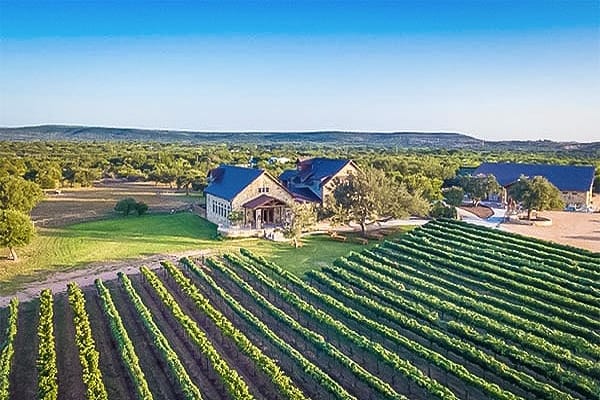
Bell Mountain AVA: The Birthplace of Texas Wine Country
Tucked into the granite hills of the Texas Hill Country north of Fredericksburg, the Bell Mountain AVA holds a distinction that most wine drinkers do not know about — it was the first single-estate AVA ever established in the United States. The wines it produces are as distinctive as its history.

In the world of American wine, firsts matter. The first commercial winery in a state. The first vintage of a variety that would go on to define a region. The first AVA designation that put a place on the map. These moments of precedent shape the story of how American wine became what it is today.
The Bell Mountain AVA has a first that almost nobody outside of Texas wine circles knows about, and it is a genuinely remarkable one: established in 1986, Bell Mountain was the first single-estate American Viticultural Area ever approved by the federal government. Not the first AVA in Texas. Not the first AVA in the South. The first single-estate AVA in the entire United States.
That distinction belongs to one man, one family, and one piece of granite-studded Hill Country land that turned out to be better suited to wine grapes than almost anyone expected.
A Mountain with a Name and a Story
Bell Mountain rises from the rolling limestone and granite terrain of Gillespie County in the Texas Hill Country, about 15 miles north of Fredericksburg — the charming German-heritage town that has become the unofficial capital of Texas wine tourism. The mountain itself is not dramatic by the standards of the American West. It tops out at roughly 1,950 feet above sea level, a modest prominence above the surrounding Hill Country plateau. But in the context of Central Texas viticulture, those extra feet of elevation, combined with the mountain's specific orientation and soil composition, create a microclimate that is meaningfully different from the valley floors and flatlands around it.
The Bell Mountain AVA covers approximately 3,000 acres, but the vineyards that define it are concentrated on the slopes and summit of the mountain itself — a compact, focused growing area that is about as different from the sprawling multi-county AVAs of California as it is possible to get. This is intimate wine country, shaped by a single geological feature and the vision of a single family.
The Oberhellmann Story: One Family, One Mountain
The history of the Bell Mountain AVA is inseparable from the history of the Oberhellmann family, and specifically from Robert Oberhellmann, the man who planted the first vines on Bell Mountain in 1974 and spent the next decade proving that the site could produce serious wine.
Oberhellmann was not a career winemaker. He was a businessman who had fallen in love with wine and with this particular piece of Texas Hill Country land. In the early 1970s, he purchased property on Bell Mountain and began experimenting with wine grape varieties, guided by the emerging research coming out of Texas A&M and the University of Texas that suggested the Hill Country's combination of altitude, thin soils, and temperature variation could support quality viticulture.
The early years were not easy. Growing wine grapes in the Texas Hill Country in the 1970s meant working without a roadmap — no established practices, no community of fellow growers to consult, no market infrastructure to sell into. Oberhellmann was essentially conducting a long-term experiment on his own land, learning through trial and error what the mountain would and would not support.
What he discovered was that Bell Mountain's specific combination of granite-based soils, elevated position, and north-facing slopes created conditions that were genuinely distinctive — different enough from the surrounding Hill Country that he believed the site deserved its own formal recognition. In 1986, after years of documentation and advocacy, the TTB agreed. Bell Mountain became the first single-estate AVA in American wine history.
The winery Oberhellmann founded — Oberhellmann Vineyards, later renamed Bell Mountain Vineyards — became the anchor of the AVA and remains the defining producer of the region to this day. The family's commitment to the site over more than five decades represents one of the most sustained acts of viticultural faith in Texas wine history.
What Makes Bell Mountain Different
The case for Bell Mountain as a distinct terroir rests on several specific characteristics that set it apart from the broader Texas Hill Country AVA that surrounds it.
Granite Soils
The Texas Hill Country is primarily limestone country — the Edwards Plateau, the geological formation that underlies most of the region, is composed of ancient marine sediments that have been uplifted and exposed over millions of years. Bell Mountain sits at the edge of the Llano Uplift, a dome of ancient Precambrian granite that pushes through the limestone in a roughly circular area centered on Llano County. The granite-based soils of Bell Mountain are fundamentally different from the limestone soils of most Hill Country vineyards — lower in calcium, higher in certain trace minerals, and with a different drainage profile that stresses vines in subtly different ways.
Granite soils are associated with some of the world's most celebrated wine regions: the northern Rhône Valley, parts of Alsace, the Beaujolais crus, the Douro Valley in Portugal. The mineral character they impart to wines — a kind of stony, almost electric quality — is distinctive and recognizable to experienced tasters. Bell Mountain's granite foundation gives its wines a mineral signature that is genuinely different from the limestone-influenced wines produced elsewhere in the Hill Country.
Elevation and Aspect
At nearly 2,000 feet, Bell Mountain sits meaningfully higher than the surrounding valley floors. That elevation translates to cooler temperatures — particularly at night — and a longer growing season that allows grapes to ripen slowly and develop complexity without losing freshness. The mountain's north-facing slopes receive less direct solar radiation than south-facing exposures, further moderating temperatures and extending the ripening window.
The combination of elevation and aspect creates a microclimate that is noticeably cooler than the surrounding Hill Country — cool enough, in fact, to support varieties like Riesling and Pinot Noir that would struggle in the warmer, lower-elevation sites that dominate Texas viticulture. This is one of the most striking aspects of Bell Mountain: it can grow grapes that simply do not belong in most of Texas.
Diurnal Temperature Variation
Like all elevated Texas wine regions, Bell Mountain benefits from significant diurnal temperature swings — the difference between daytime highs and nighttime lows that is one of the most important factors in producing wines with both ripeness and freshness. On Bell Mountain, those swings can exceed 35 to 40 degrees Fahrenheit during the growing season, preserving natural acidity and aromatic complexity in grapes that ripen under warm Texas sun.
Grapes of the Bell Mountain AVA
Cabernet Sauvignon
Cabernet Sauvignon is the most widely planted variety on Bell Mountain and the one that has most consistently demonstrated the site's potential for serious red wine. The granite soils and elevated position give Bell Mountain Cabernet a distinctive character — dark fruit concentration, firm tannins, and a mineral undercurrent that distinguishes it from the richer, more extracted Cabernets produced in warmer Texas regions. The best examples are structured and age-worthy, with a complexity that rewards patience in the cellar.
Riesling
Perhaps the most surprising variety in the Bell Mountain portfolio, Riesling has proven genuinely well-suited to the mountain's cooler microclimate. The variety's natural high acidity — its defining characteristic in its German homeland — is preserved by the cold nights, and the granite soils add a mineral precision that echoes the great Rieslings of the Mosel and Alsace. Bell Mountain Riesling is not a common wine, but it is one of the most compelling arguments for the site's distinctiveness: a wine that could not be made anywhere else in Texas, and that holds its own against serious Rieslings from anywhere in the world.
Pinot Noir
Pinot Noir on Bell Mountain is a genuine curiosity — and a genuine achievement. The variety is notoriously difficult to grow in warm climates, demanding cool temperatures, good drainage, and careful canopy management to produce wines of any quality. Bell Mountain's elevation and north-facing slopes create conditions just cool enough to make it work, at least in the right vintages. The results are not Burgundy, and they are not trying to be. They are Texas Pinot Noir — lighter in color than most Texas reds, with red fruit, earth, and a delicacy that is genuinely surprising given the surrounding landscape.
Chardonnay
Chardonnay performs well on Bell Mountain's cooler slopes, producing wines with more natural acidity and restraint than the full-bodied, tropical expressions common in warmer Texas regions. The granite soils add a mineral quality that gives the wine structure and length, and the best examples show a Burgundian elegance — not identical to Côte de Beaune, but clearly in the same family of ideas.
Cabernet Franc
Cabernet Franc has found a comfortable home on Bell Mountain, benefiting from the cooler temperatures and granite soils that allow the variety to express its characteristic aromatic complexity — red fruit, graphite, dried herbs, a hint of violet — without the green, underripe notes that can plague Franc in sites that are too cool, or the jammy over-ripeness that comes from sites that are too warm. Bell Mountain sits in the sweet spot, and the Cabernet Franc produced here is among the most interesting expressions of the variety in Texas.
Sauvignon Blanc and Other Whites
Sauvignon Blanc, Gewürztraminer, and a handful of other aromatic white varieties round out the Bell Mountain portfolio. Gewürztraminer, in particular, is a variety that rarely appears in Texas wine, but the mountain's cooler microclimate allows it to retain the aromatic intensity — lychee, rose petal, ginger — that makes the variety so distinctive in Alsace. It is a niche wine, but a fascinating one.
Wineries of the Bell Mountain AVA
Bell Mountain Vineyards (Oberhellmann Vineyards)
The founding winery of the Bell Mountain AVA and the only estate producer operating entirely within its boundaries, Bell Mountain Vineyards is the essential reference point for understanding what this site can do. The winery has been producing wine from Bell Mountain fruit since the late 1970s, and the depth of experience shows in wines that are consistently among the most distinctive and terroir-expressive in Texas.
The tasting room, set against the backdrop of the mountain itself, offers one of the most authentic winery experiences in the Hill Country — a place where the history of Texas wine is palpable and the connection between the land and the glass is impossible to miss. The Cabernet Sauvignon and Riesling are the essential bottles to seek out, but the entire portfolio rewards exploration.
Becker Vineyards
While Becker Vineyards is headquartered in Stonewall, in the heart of the Hill Country, the winery has long been one of the most important advocates for Bell Mountain-area fruit and has sourced grapes from the region for several of its varietal wines. Becker is one of the most decorated wineries in Texas, with a track record of producing wines that consistently outperform expectations for the state. Their engagement with Bell Mountain terroir has helped build awareness of the AVA among Texas wine drinkers who might not otherwise seek it out.
Grape Creek Vineyards
Located near Fredericksburg, Grape Creek Vineyards draws on fruit from across the Hill Country, including the Bell Mountain area, for its portfolio of varietal and blended wines. The winery has been a consistent performer in Texas wine competitions and is a good introduction to the broader Hill Country wine scene for visitors making their first foray into the region.
Kuhlman Cellars
A newer addition to the Hill Country wine scene, Kuhlman Cellars has quickly established itself as one of the most serious and thoughtful producers in the region. Their focus on estate-grown fruit and minimal-intervention winemaking has produced wines that show genuine terroir expression, and their engagement with Bell Mountain-area vineyards has yielded some of their most compelling releases. The winery's tasting room, designed with the same attention to detail as the wines themselves, is one of the most pleasant places to spend an afternoon in the Hill Country.
Bell Mountain and the Broader Hill Country Story
The Bell Mountain AVA exists within — and is surrounded by — the much larger Texas Hill Country AVA, which covers roughly 15,000 square miles across nine counties and encompasses hundreds of wineries. The relationship between the two designations is worth understanding, because it illuminates something important about how American wine geography works.
The Texas Hill Country AVA is one of the largest in the United States by area, and it encompasses an enormous range of soils, elevations, and microclimates. Not all Hill Country wine is the same — a wine from the limestone flats near Fredericksburg is a fundamentally different product from a wine grown on Bell Mountain's granite slopes at nearly 2,000 feet. The Bell Mountain AVA exists precisely to make that distinction legible on a label, to give producers and consumers a way to communicate about the specific character of this specific place.
That is what AVA designations are supposed to do, and Bell Mountain does it better than most. The wines produced here are genuinely different from the broader Hill Country category — more mineral, more structured, more capable of aging, and more expressive of a specific geological identity. The first-single-estate-AVA designation is not just a historical footnote. It is a statement about the importance of place in wine, and about the willingness of one family to make that case to the federal government and to the wine-drinking public.
The Historical Significance
It is worth pausing on the historical significance of what the Oberhellmann family accomplished in 1986, because it tends to get lost in the broader narrative of Texas wine's growth.
When Robert Oberhellmann petitioned the TTB for a single-estate AVA designation, there was no precedent for it. The AVA system, established in 1980, had been used to designate broad geographic regions — Napa Valley, Willamette Valley, the Texas Hill Country. The idea that a single estate, a single mountain, a single family's land could constitute a distinct enough terroir to warrant its own federal designation was genuinely novel.
The TTB agreed, and in doing so established a precedent that has shaped American wine geography ever since. Single-estate AVAs are still relatively rare — the system tends to favor larger geographic designations — but they exist, and Bell Mountain is why. Every time a producer anywhere in the United States makes the case that their specific piece of land is distinctive enough to deserve its own appellation, they are building on the foundation that the Oberhellmann family laid in the granite hills north of Fredericksburg.
That is a legacy worth knowing about, and a wine worth drinking in its honor.
Visiting Bell Mountain
Bell Mountain is an easy day trip from Fredericksburg, which is itself about 70 miles west of Austin and 80 miles north of San Antonio. The drive north on US Highway 87 from Fredericksburg to the Bell Mountain area takes about 20 minutes and passes through some of the most beautiful Hill Country landscape in Texas — rolling granite hills, live oak mottes, the occasional deer standing in a cedar brake.
The Bell Mountain Vineyards tasting room is the essential stop, and it is worth calling ahead to confirm hours and availability, particularly during the busy fall harvest season. The surrounding area offers excellent hiking, wildlife viewing, and the particular pleasure of a landscape that has not been entirely overrun by wine tourism — a quality that is increasingly rare in the Hill Country as the region's popularity has grown.
The best time to visit is fall (September–November), when harvest activity brings the vineyards to life and the Hill Country temperatures become genuinely pleasant after the brutal Texas summer. Spring (March–May) is also excellent, with wildflowers and mild weather. Summer visits are possible but come prepared — even at Bell Mountain's elevation, July and August in Central Texas are not for the faint of heart.
If you are building a Hill Country wine itinerary, consider pairing a Bell Mountain visit with stops in Fredericksburg and the surrounding Stonewall area, where the concentration of wineries is highest. The contrast between the broad, flat valley-floor vineyards near Fredericksburg and the elevated, granite-soiled slopes of Bell Mountain tells the Hill Country wine story in miniature — a reminder that even within a single wine region, place matters enormously.
The Bottom Line
The Bell Mountain AVA is a small place with an outsized story. It is the birthplace of the single-estate AVA concept in American wine, the product of one family's stubborn faith in a piece of granite-studded Texas Hill Country land, and the source of some of the most distinctive and terroir-expressive wines in the state.
The wines are not the biggest or the boldest that Texas produces. They are something more interesting: wines that taste like somewhere specific, that carry the mineral signature of ancient granite and the freshness of cool mountain nights, that reward the drinker who pays attention to what is in the glass.
In a wine world that often rewards scale and spectacle over subtlety and place, Bell Mountain is a quiet argument for the other way of doing things. It is an argument worth hearing — and a glass worth pouring.
Explore Topics
Written by
Chuck
Chuck Hoeffler is the founder and editor of The American Vine. He loves tasting and writing about American wine, with a particular focus on regions and wineries that deserve more attention than they typically receive.