Texas High Plains AVA: The Surprising Heart of Texas Wine
High altitude, intense sun, and sandy soils make the Texas High Plains one of America's most distinctive wine regions — and most drinkers have never heard of it.
When most people think of Texas wine, they picture the rolling cedar hills and limestone soils of the Hill Country west of Austin. That region gets the press, the tourism, and the Instagram posts. But if you want to understand where Texas wine actually comes from — where the grapes are grown — you need to drive five hours northwest, up onto a vast, wind-swept plateau sitting more than 3,000 feet above sea level.
Welcome to the Texas High Plains AVA. It is not glamorous. There are no charming tasting room villages, no vineyard-view restaurants with curated charcuterie boards. What there is, however, is some of the most compelling terroir in the American South — and a wine story that is older, stranger, and more important than most people realize.
A Region Defined by Extremes
The Texas High Plains AVA was established in 1993, covering roughly 8 million acres across the Llano Estacado — the "staked plains" that stretch across the Texas Panhandle and into eastern New Mexico. It is a big, flat, largely treeless landscape that can feel almost lunar in its austerity. Summers are blazing hot during the day and surprisingly cool at night. Winters are brutal. Wind is a constant companion.
And yet those extremes are precisely what make this place so interesting for viticulture.
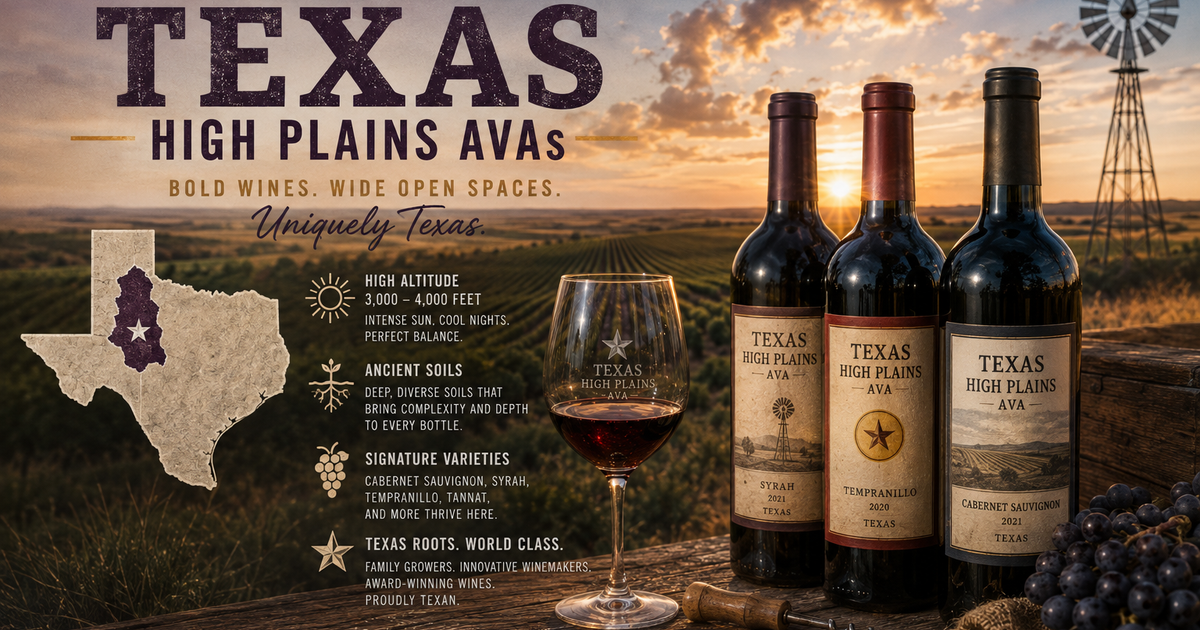
The elevation — ranging from about 3,000 to 4,000 feet — gives the High Plains a diurnal temperature swing of 30 to 40 degrees Fahrenheit between day and night. That dramatic shift is the same phenomenon that makes the Willamette Valley and the Finger Lakes so compelling for aromatic whites and elegant reds. Heat builds sugar and ripeness during the day; cool nights preserve acidity and freshness. The result is grapes with both concentration and structure — a combination that is genuinely difficult to achieve in hotter, lower-elevation regions.
The soils are deep, sandy, and well-drained — a legacy of ancient wind-deposited sediment. Sandy soils are naturally resistant to phylloxera, the root louse that devastated European vineyards in the 19th century and forced most of the world's viticulture onto grafted rootstocks. Many High Plains vines grow on their own roots, which is increasingly rare and increasingly prized.
Rainfall is scarce — typically 15 to 18 inches per year — so most vineyards rely on drip irrigation fed by the Ogallala Aquifer, the vast underground reservoir that underlies much of the Great Plains. Water management is one of the defining challenges of farming here, and it is a challenge that is only growing more pressing as the aquifer slowly declines.
The History: Older Than You Think
The story of wine grapes on the Texas High Plains begins not with boutique winemakers chasing terroir, but with a university and a practical problem.
In the 1970s, Texas A&M University researchers began experimenting with wine grape varieties at the Texas Agricultural Experiment Station in Lubbock. The goal was straightforward: find crops that could thrive in the harsh High Plains climate and provide economic diversification for a region heavily dependent on cotton, cattle, and oil. What they discovered was that the region's combination of altitude, sandy soils, and temperature swings was genuinely well-suited to a wide range of Vitis vinifera varieties.
The first commercial winery in the modern Texas wine era, Llano Estacado Winery, was founded in 1976 just outside Lubbock by two Texas Tech professors — Dr. Clinton McPherson and Dr. Robert Reed. It was a pioneering act of faith in a region with no winemaking tradition, no established market, and no roadmap. Llano Estacado is still operating today and remains one of the most important wineries in the state.
Cap Rock Winery followed in 1988, and by the time the AVA was formally established in 1993, the region had a small but serious cluster of producers committed to proving that Texas could make world-class wine.
The development that truly transformed the High Plains, however, was the emergence of the region as the primary grape-growing source for the entire Texas wine industry. Today, the Texas High Plains AVA produces an estimated 80 to 90 percent of all Texas-grown wine grapes. Wineries in the Hill Country, in Austin, in Dallas — many of them source their fruit from High Plains vineyards. The region is, in a very real sense, the agricultural engine of Texas wine, even if it rarely gets the credit.
The Grapes: A Surprisingly Diverse Palette
One of the most interesting things about the Texas High Plains is the sheer range of varieties that thrive here. This is not a single-grape region with a signature varietal identity. It is a place where winemakers and growers have spent decades experimenting, and the results are genuinely eclectic.
Tempranillo has emerged as perhaps the most exciting red variety on the High Plains. The Spanish grape — the backbone of Rioja and Ribera del Duero — seems to have found a spiritual home in West Texas. The combination of heat, altitude, and sandy soils produces Tempranillo with real depth and structure, often with a savory, earthy quality that echoes its Spanish origins. Several producers are now making High Plains Tempranillo that can hold its own against serious Spanish examples.
Viognier is the white variety that has generated the most excitement. The aromatic Rhône grape produces wines here with the variety's characteristic floral intensity — peach, apricot, honeysuckle — but with a freshness and acidity that the variety can sometimes lack in warmer climates. High Plains Viognier is one of the genuine surprises of American white wine.
Cabernet Sauvignon and Merlot are widely planted and produce wines that tend toward ripe, generous fruit with good structure. They are not always the most nuanced expressions of those varieties, but at their best they are genuinely impressive.
Mourvèdre, Grenache, and Syrah — the classic Rhône red trio — are increasingly planted and increasingly compelling. The High Plains' combination of heat and altitude suits these varieties well, producing wines with the kind of spice, dark fruit, and savory depth that makes Rhône-style blends so satisfying.
Roussanne and Marsanne, the white Rhône varieties, are also gaining traction, producing wines with texture and weight that pair beautifully with the region's bold red-friendly cuisine.
The Sub-AVAs: Brownfield and Texline
Within the broader Texas High Plains AVA, two sub-appellations were established in 2021, offering more precise geographic designations for growers and producers who want to communicate specific terroir.
The Brownfield AVA covers the southern portion of the High Plains, centered around Terry County. Elevations here run from about 3,200 to 3,600 feet. The soils are predominantly deep, fine sandy loam — excellent drainage, low fertility, and that natural phylloxera resistance. Brownfield is home to some of the region's most established vineyards and is particularly well-regarded for Tempranillo and Cabernet Sauvignon.
The Texline AVA, in the far northern Panhandle near the New Mexico border, sits at higher elevations — up to 4,500 feet in some areas — and experiences even more dramatic temperature swings. The growing season is shorter and cooler, which pushes growers toward earlier-ripening varieties and produces wines with notably higher natural acidity. Texline is still an emerging story, but the early results from producers working with fruit from this area are genuinely exciting.
Wineries Worth Knowing
Llano Estacado Winery is the founding institution of Texas wine and remains essential. Their Signature Series wines — particularly the Tempranillo and the Viognier — represent the High Plains at its most polished and consistent. The winery produces a staggering range of wines at multiple price points, and the quality-to-value ratio across the lineup is hard to beat.
McPherson Cellars, founded by Kim McPherson (son of Llano Estacado co-founder Clinton McPherson), operates out of a beautifully restored 1930s Coca-Cola bottling plant in downtown Lubbock. Kim is one of the most respected winemakers in Texas, and his Rhône-focused lineup — the Roussanne, the Viognier, the GSM blends — is consistently excellent. If you are trying to understand what the High Plains can do with Rhône varieties, start here.
Duchman Family Winery, based in Driftwood but sourcing heavily from High Plains fruit, has become one of the most important advocates for Italian varieties in Texas. Their Vermentino, Montepulciano, and Dolcetto are made from High Plains grapes and represent some of the most interesting Italian-varietal wine being made in America outside of California.
Lost Draw Cellars in Lubbock is a newer producer that has quickly established a reputation for serious, terroir-focused wines. Their single-vineyard Tempranillos and Viogniers are among the most compelling wines coming out of the region right now, and the winery's commitment to showcasing specific High Plains vineyards is exactly the kind of work that will help define the region's identity going forward.
Bingham Family Vineyards is one of the largest and most important grape-growing operations on the High Plains, farming over 1,000 acres across multiple sites. They also produce their own wines under the Bingham label, and the estate-grown Tempranillo and Cabernet Franc are worth seeking out. Understanding Bingham is essential to understanding the High Plains, because their fruit ends up in bottles from wineries across the state.
What to Drink
If you are new to Texas High Plains wine, here is a simple roadmap:
Start with a McPherson Cellars Viognier. It is the clearest expression of what this region does with aromatic whites — floral, fresh, and genuinely distinctive. Then move to a Llano Estacado Tempranillo to understand the red side of the equation. If you want to go deeper, find a Lost Draw single-vineyard Tempranillo and compare it to a Spanish Rioja. The conversation that comparison starts is worth having.
For food pairing, think bold. High Plains wines are built for Texas food — smoked brisket, chile-rubbed pork, grilled lamb. The Tempranillo and the GSM blends are particularly well-suited to anything coming off a smoker.
The Road Ahead
The Texas High Plains faces real challenges. Water scarcity is the most pressing — the Ogallala Aquifer is not replenishing at the rate it is being drawn down, and long-term sustainability requires serious attention. Climate change is adding heat stress and unpredictability to an already demanding growing environment. And the region still struggles with the perception problem that afflicts all of Texas wine: the assumption, common among serious wine drinkers, that nothing important happens south of the Mason-Dixon line.
That perception is wrong, and it is slowly changing. The High Plains is producing wines that deserve serious attention — wines with genuine character, real terroir, and a story that is uniquely American. It is a region that rewards curiosity.
The next time you see a Texas wine on a list, ask where the grapes were grown. Chances are, the answer is the High Plains. And chances are, that is a very good thing.
Explore Topics
Written by
Chuck
Chuck Hoeffler is the founder and editor of The American Vine. He loves tasting and writing about American wine, with a particular focus on regions and wineries that deserve more attention than they typically receive.